
La Plata County Criminal Court Cases
La Plata District Court hears felony cases. County Court handles state misdemeanors, many traffic matters, and preliminary felony proceedings. Both state courts use the clerk at the La Plata County Courthouse in the Sixth Judicial District. Durango, Bayfield, and Ignacio municipal courts keep their own files for qualifying local-code cases. Picking the wrong clerk is a common reason a case seems to be missing.
The courthouse is at 1060 E. Second Ave., Room 106, Durango, CO 81301. Call 970-247-2304 or email laplataclerk@judicial.state.co.us for case files, archived searches, inspection, plain copies, or certified dispositions. The building and clerk counters have different closing times. Current clerk hours are 7:30 a.m. to 4:30 p.m., while the building stays open later. Security screening applies.
Route La Plata Criminal Cases
A case number is useful only when paired with the right court. Felony prosecutions go to District Court. State misdemeanors and many traffic cases go to County Court. A Durango Police or Fort Lewis College Police summons for a municipal violation may remain in Durango Municipal Court. Sheriff and State Patrol citations instead route to Combined Court.
| Record question | Correct office | Typical result |
|---|---|---|
| Felony charge | La Plata District Court | District case file and disposition |
| State misdemeanor | La Plata County Court | County case file and sentence |
| City violation | Applicable municipal court | Summons, docket, and city judgment |
| Federal prosecution | U.S. District Court for Colorado | PACER docket and federal filings |
Police and detention offices do not certify the final court result. Their records can show the arrest or booking charge, but the prosecutor may later amend or decline it.
Searching La Plata County Case Records
The Colorado Judicial Branch docket search is a scheduling tool with only one week of data. It is not a full historical case index or document library. Leaving optional fields blank can display the selected court’s full weekly docket. A blank result does not act as a no-record certificate.
- Select La Plata County and then the correct court.
- Use the case number when known; otherwise search by party name.
- Review the division, hearing date, time, caption, and event type.
- Record the full case number and read it as year, case class, and sequence.
- Contact the clerk for the register of actions, pleadings, disposition, or certified copy.
The official La Plata docket form shows the county-specific search interface.
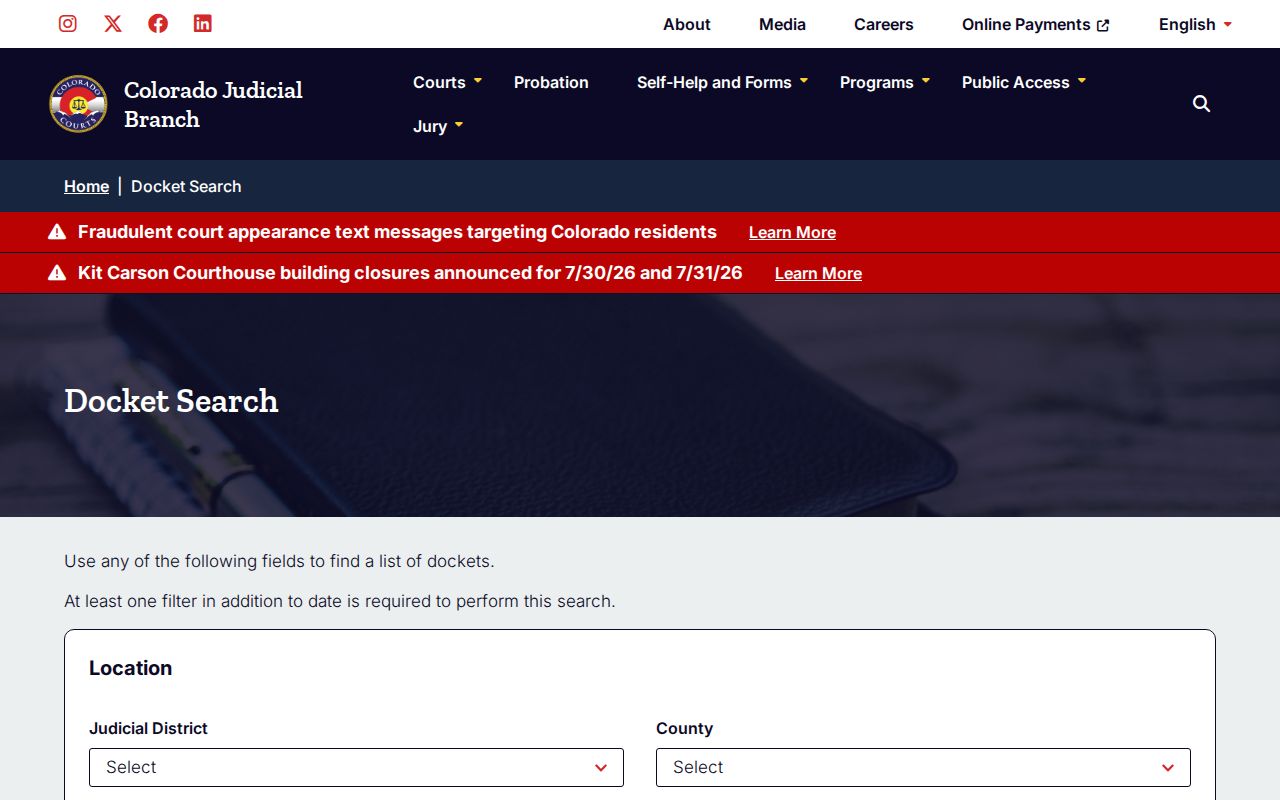
Its fields narrow a weekly calendar entry, while the clerk supplies the underlying La Plata County criminal court record.
| Field Label | Type | Required | Notes |
|---|---|---|---|
| County | Dropdown | No | Select La Plata for local cases |
| Court | Dropdown | Conditional | Required after selecting county |
| Division | Text or dropdown | No | Narrows the judicial division |
| Date Range | Date control | Unspecified | Public notice limits data to one week |
| Case Number | Compound | No | Year, case class, and sequence |
| Party Names | Text | No | Last or company name; first name can narrow |
| Attorney Bar Number | Text | No | Attorney-based docket lookup |
Older La Plata Criminal Case Files
An old case may fall outside the online week even when its paper or archived file remains available. Give the clerk the case number, subject’s name, approximate filing year, and court level. Ask whether the desired document is open to inspection, how delivery works, and what a plain copy costs before ordering.
The statewide fee list sets certification at $20 and fax delivery at $1 per page. Research did not locate a current local plain-copy or name-search fee, so confirm it with the clerk. In-person inspection can help identify the exact pages before paying. Public-access terminals may assist at the courthouse, but official copies still come from the clerk.
A register of actions is often the best first request. It provides the chronological case events needed to select a complaint, motion, minute order, judgment, or sentence document without buying the entire file.
Inside a La Plata County Case File
A case file records prosecution and result. It may contain the complaint, information, or indictment; appearances; motions; minute orders; plea; trial result; judgment; financial ledger; restitution; and sentence terms. It is not interchangeable with a police narrative, booking entry, or CBI history.
| Case Number & Court | Filing year, case class, sequence, and the court holding the file |
|---|---|
| Charging Document | Complaint, information, or indictment stating filed accusations |
| Docket Entries | Chronological filings, hearings, orders, and case events |
| Hearing Dates | Scheduled date, time, division, and event type |
| Disposition & Judgment | Outcome for each charge, including dismissal, plea, acquittal, or conviction |
| Sentence & Conditions | Court-ordered custody, probation, fines, costs, restitution, and other terms |
Victim names, protected addresses, juvenile material, sealed matters, and personal identifiers may be absent or redacted. A docket row alone does not expose the full charge history or certified outcome.
Filed La Plata Charges Can Change
The arresting agency selects a booking charge based on the event. The prosecutor decides what to file. These labels can differ, and neither should be treated as the final disposition. Durango Police, the Sheriff, and other agencies retain their own reports even after the court case develops.
The Durango Police release form illustrates the separation between records of official action and other criminal justice records.
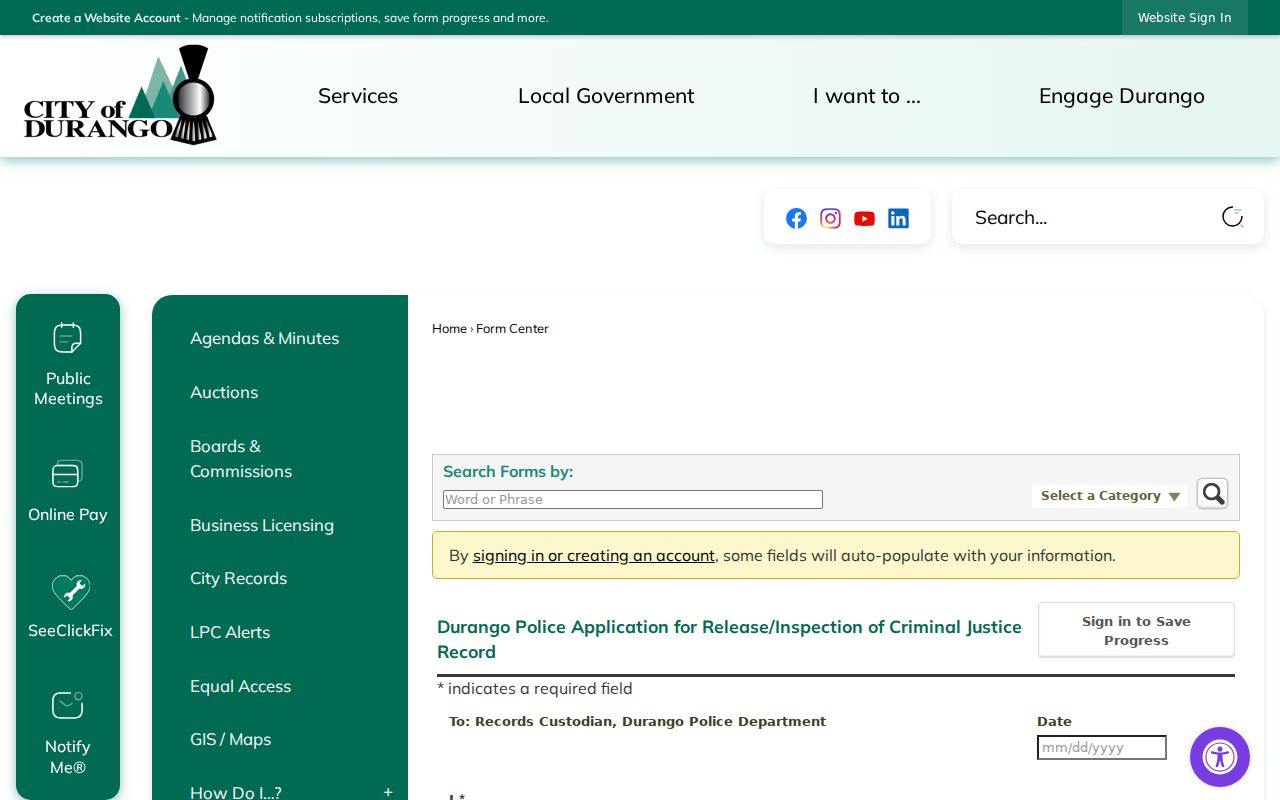
That agency form can produce police material, while a filed charge, plea, and judgment must be confirmed in the court case file.
For a recent arrest, check the agency report and booking channel first. Then use the La Plata County arrest lookup before moving to the clerk once prosecutors file a state case.
How a Criminal Case Moves
A state criminal case may begin with an arrest or summons. A first appearance addresses advisement and release. The prosecutor files charges. Felonies may include a preliminary hearing or grand-jury route. Arraignment is the formal plea stage. Motions and pretrial conferences follow, then a plea or trial, judgment, sentence, appeal, and supervision as applicable.
Case flow: Charges Filed › Arraignment › Pretrial › Plea or Trial › Disposition › Sentencing
Each point creates a different docket event. A deferred judgment delays judgment while set conditions are completed. A dismissal ends a charge without conviction. An acquittal is a not-guilty finding. These terms should not be merged when reading La Plata County criminal court cases.
Read La Plata Case Outcomes
The final disposition should be read charge by charge. One count may be dismissed while another produces a plea and sentence. A minute order is a short record of court action. The judgment states the legal result, and the sentence states the consequence.
- Disposition
- The final result recorded for a charge.
- Dismissal
- A charge ends without a conviction.
- Acquittal
- A judge or jury finds the defendant not guilty.
- Deferred judgment
- Judgment is delayed under court-ordered terms.
- Restitution
- Payment ordered for a qualifying loss.
A CBI history may lack a disposition if reporting was delayed or identifiers did not match. Compare the repository entry with the clerk’s record and use the CBI challenge process only after obtaining the court outcome.
Federal Cases Beyond La Plata Courts
La Plata County lies within the U.S. District Court for the District of Colorado. Federal criminal cases do not appear merely because someone searches the La Plata state docket. PACER requires an account and provides federal dockets and filed documents, subject to current federal usage fees and waiver rules.
The official PACER service is the federal case-record source.
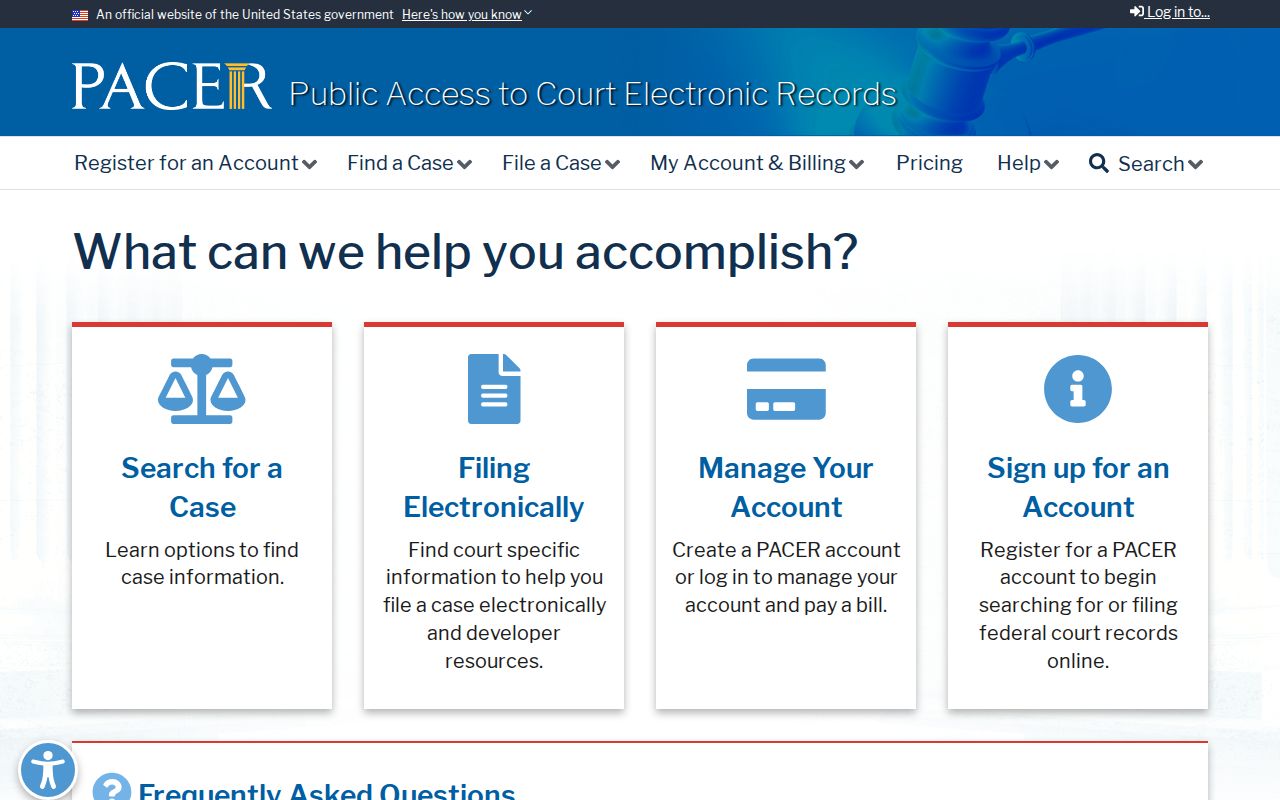
This federal layer is separate from Colorado Judicial Branch dockets and La Plata court files. Confirm the correct federal filing location rather than assuming a hearing occurred in Durango.
Federal custody uses the Bureau of Prisons locator. An FBI Identity History Summary is a subject-only fingerprint product and does not replace PACER filings or a court-certified disposition.
Case Record Access & Restrictions
Colorado court records follow Judicial Branch public-access policy. Court files are generally available unless a statute, rule, or order limits access. Juvenile matters, sealed cases, victim information, protected addresses, financial identifiers, medical details, and other protected data may be withheld or redacted.
C.R.S. sections 24-72-701 through 24-72-710 govern adult sealing and automatic-sealing paths. A sealed case’s absence is not a database error. Sealing limits public access but does not necessarily destroy every record or erase all authorized government access.
Access pointer: Ask the clerk whether the case exists, whether it is publicly inspectable, and which rule supports any denial. Do not ask police records staff to supply court discovery or a certified judgment.
Municipal cases stay with their city clerks. State cases stay with the La Plata clerk. Federal matters stay in the federal court system. That custodian-first approach provides the most reliable court record.