
Checking Criminal History in Durango
A useful Durango criminal records search follows the record, not just the person’s name. The city police report states what officers observed. A municipal summons file shows a local-law case. A booking file documents custody at the county jail. A state court file shows charges filed under Colorado law. The Colorado Bureau of Investigation history is another product, built from fingerprint-linked arrest cycles and reported outcomes. None replaces the others.
- Identify whether Durango Police, Fort Lewis College Police, the Sheriff, or another agency created the event record.
- Use the Durango Police release and inspection process for a city report, official arrest action, dispatch audio, or available media.
- Call the Durango Municipal Court clerk when a city summons or municipal bench warrant may exist.
- Check La Plata detention and state court channels for county booking, felony, misdemeanor, or state traffic records.
- Use CBI ICHC for a paid Colorado name-based history, then compare each entry with the court disposition.
For old or certified court material, the clerk is the key source. The public Colorado docket shows only a one-week schedule, so a blank result cannot certify that no Durango criminal case exists. A broader county workflow appears in the La Plata County criminal history overview.
Durango Criminal Records Request Form
The current Durango Police forms page directs requesters to the city’s secure release and inspection process. It separates records of official action from other criminal justice records. The form also distinguishes reports from dispatch audio, Axon video, photographs, and other digital media. That split matters because each item can have a different review burden and charge.
| Requester details | Name, street address, city, state, ZIP, and phone number |
|---|---|
| Record choice | Official action, criminal justice record, or audio and video material |
| Dispatch scope | Initial call, radio traffic, or the entire incident |
| Event detail | Incident-identifying facts and contact information requested by the form |
| Current response | Cost or access response within three working days, with a possible seven-working-day extension |
Current police research and redaction costs $10 per quarter hour, plus $0.25 for each printed page. Dispatch audio and Axon video cost $40 per hour. Axon photographs cost $0.25 each, while other available digital media cost $25 per CD, DVD, or flash drive. The city may collect at least half in advance. Older fee text should not be used in place of the live forms page.
Durango Police Department Records
Durango Police Records operates at 990 E. Second Ave., Durango, CO 81301. The department’s main number is 970-375-4700, and Records is 970-375-4750. Counter hours are Monday through Friday, 8 a.m. to 4 p.m. Investigations has a separate line at 970-375-4730. Non-emergency dispatch uses 970-385-2900. Calling can confirm the right custodian, but a call alone does not produce a certified Durango criminal record.
The records unit holds city-created incident and arrest material. It does not hold every record connected to an event. A court filing belongs to the relevant clerk, while a booking belongs to La Plata Detentions. CBI also states that it does not possess another agency’s police report. Requesters should provide the date, place, event details, people involved, and an incident number when known.
The city’s police building page gives visual context for the Durango Police location.
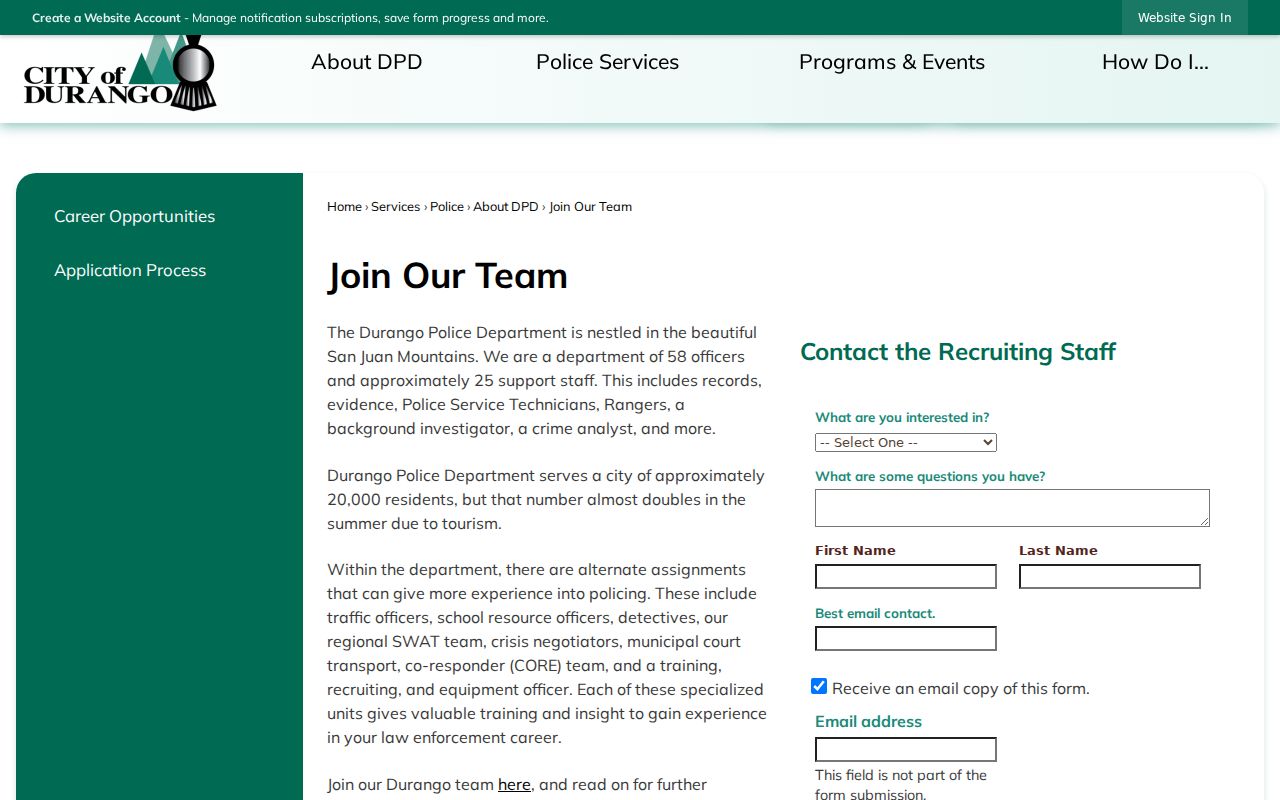
This is the city records destination for Durango Police reports, not the county jail or state court clerk counter.
Note: Photo ID and a precise incident description can reduce delays when staff must distinguish similar Durango police records.
Durango Police Records by Numbers
Durango had 19,071 residents in the 2020 Census and covers 14.7 square miles. Yet the police department says summer visitors nearly double its service population. The department describes 58 officers and about 25 support staff. That seasonal load helps explain why a clear Durango criminal records request is more useful than a broad demand for every item tied to a common name.
The 2024 department report counted 21 reported rapes, 10 robberies, 83 aggravated assaults, 789 thefts, and 37 motor-vehicle thefts. These are police offense counts, not court convictions or a countywide crime rate. The report adds needed context: seven rape reports concerned earlier incidents, three robberies involved domestic violence, and 23 aggravated assaults involved law enforcement. Of the theft reports, 143 involved vehicles and 104 involved bicycles. Police reported that 33 of 37 stolen vehicles were recovered.
Those figures show why record labels matter. A police count records a reported offense. An arrest record documents official action. A municipal or county court file shows whether prosecutors filed a charge and how it ended.
Durango Arrests and Bookings
Durango Police creates the arrest report, but city arrestees are booked through La Plata County detention at 742 Turner Drive. Booking creates its own record: identity and property intake, photograph, fingerprints, alleged charges, screening, classification, bond, and release data. A fingerprinted arrest can later create or update a CBI arrest cycle. Those steps do not turn an allegation into guilt.
La Plata County does not host a native public jail roster. Its official inmate page routes current county custody searches to VINELink. Call detention at 970-247-1161, option 2, if the correct channel is unclear. A booking sheet or other permitted custody record may also be requested under the Colorado Criminal Justice Records Act. Once a sentenced person moves to state custody, the correct source becomes CDOC Offender Search.
A city arrest can thus create four records: the Durango Police narrative, the county booking entry, the court case, and the CBI arrest cycle. Their dates and charges may differ. For the full custody route, use the county arrest lookup.
Durango Online Incident Records
Durango offers online self-reporting for a narrow set of non-emergencies. The event must occur within city limits, have no known suspect, and not occur on a state highway. Eligible categories are property damage, lost property, telephone harassment, theft, and a supplement to an existing report. Emergencies go to 911. Other incidents go through non-emergency dispatch.
After submission, the system issues confirmation, a case number, and a printable copy at no charge. Staff reviews each report and may follow up. A false report is a crime. This channel creates a report; it does not search someone else’s Durango criminal history or replace the release process for an existing police file.
The city’s broader public records portal and record locator cover municipal material, but police criminal justice records still use the police channel. Selecting the wrong portal can slow a request because criminal justice files follow CCJRA rules and agency review.
Municipal Court Records in Durango
Durango Municipal Court is at 949 E. Second Ave. and keeps summonses issued by Durango Police, Fort Lewis College Police, and certain La Plata Animal Protection matters for municipal-law violations. The clerk is available at 970-375-5020, Monday through Friday from 7:30 a.m. to 4:30 p.m. State Patrol and Sheriff citations go to Combined Court instead, which is a common source of wrong-counter searches.
The official Durango Municipal Court page explains the court’s city-level case scope.
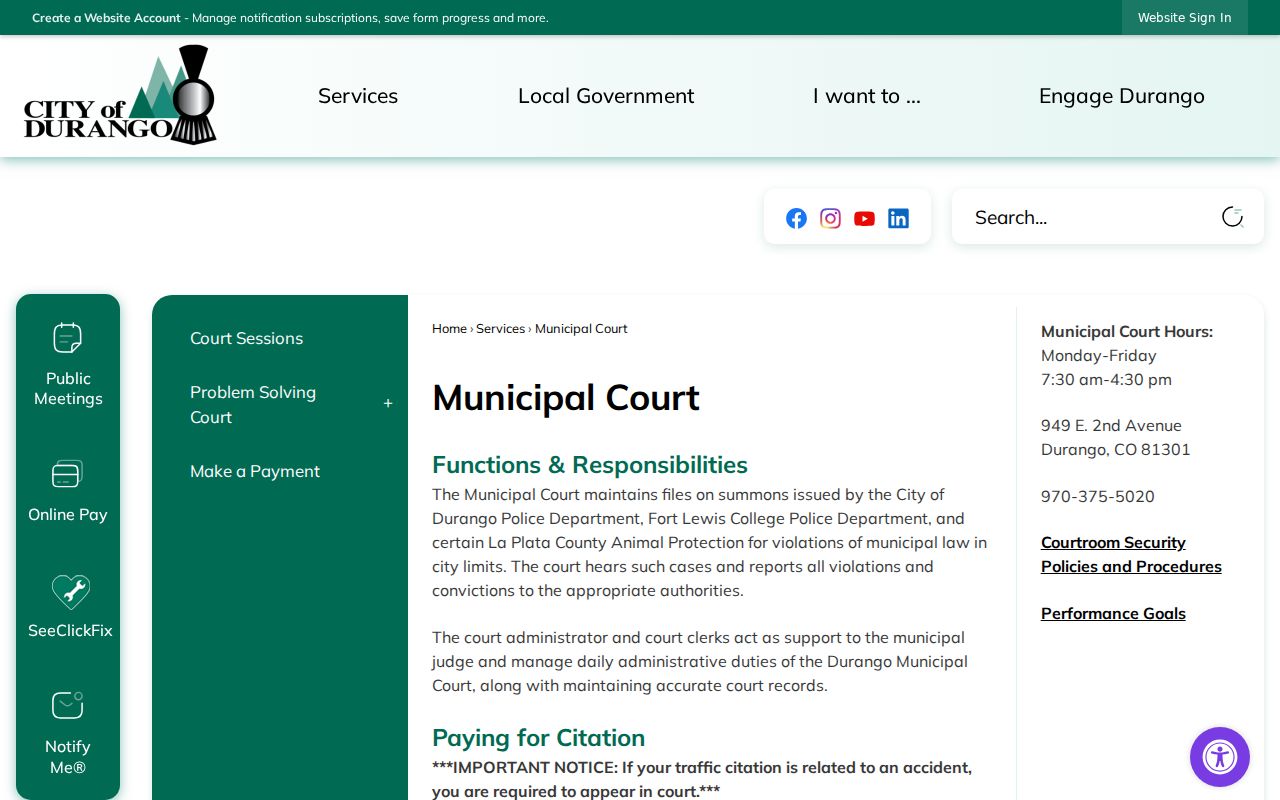
The pictured court source helps distinguish a Durango municipal summons from a felony or state misdemeanor file held by the La Plata County clerk.
| Court Name | Durango Municipal Court |
|---|---|
| Case Types Heard | Municipal violations, qualifying traffic matters, and nontraffic city summonses |
| Case Lookup Channel | Municipal Court clerk by phone or at the counter |
| What the File Shows | Summons, scheduled appearance, plea, orders, disposition, and payment information as applicable |
| Copies & Fees | Confirm current availability and charges with the clerk |
Durango Court Appearance Records
Some Durango citations cannot simply be paid online. Accident-related citations require an appearance. The same is true for reckless driving, eluding, speed contests, careless driving that causes injury or death, driving 25 or more miles per hour above the limit, no insurance, no valid license, unlawful license use, and all nontraffic offenses.
Quicket, mail, and counter payment options do not convert a mandatory-appearance case into a payable citation. Check the summons and contact the clerk. Interpreters are available. If a missed appearance may have led to a city bench warrant, Municipal Court is the right first call; county court handles a warrant tied to a state charge.
Check before paying: A payment channel does not waive a required Durango court appearance or resolve a related warrant.
Where Durango Criminal Records Go
A Durango incident can stay entirely within city systems, or it can move into county and state records. A municipal summons remains with Durango Municipal Court. A felony or state misdemeanor is filed in La Plata District or County Court. The police narrative remains with the creating agency even after a prosecutor changes or declines the booking charge.
Record flow: Durango Police › La Plata County Courts › Colorado Bureau of Investigation
The flow is not instant. Police first create the event record. Detention records custody. Prosecutors choose filed charges. The court later reports a disposition, which may reach the CBI history after a delay. A missing outcome should be checked with the court clerk before using CBI’s correction process.
Durango Police also says the La Plata County Sheriff oversees sex-offender registration inside the city. That is a separate local and state registry path, not a municipal court record.
Durango Criminal Diversion Records
Judge Beth Padilla took office on July 1, 2026 and stated plans to continue and expand Durango’s Problem Solving Court. It is a pre-plea diversion path for low-level charges that centers on accountability and services. A diversion case should not be read as though a standard conviction followed the summons.
Ask the municipal clerk what portion of a specific Durango court record is public and how the outcome is described. Terms such as dismissal, acquittal, and deferred judgment have different meanings. A dismissal ends the charge without a conviction. An acquittal is a not-guilty finding. A deferred judgment delays judgment under set terms. Problem-solving participation may have its own docket entries and access limits.
For self-review, obtain the final disposition rather than relying on the first summons or an old hearing date. That record is the best way to understand whether the city case remains open, ended through diversion, or reached another result.
Older Durango Court Records
Durango Municipal Court dates to a 1957 ordinance, while municipal judges have served the city since 1881. Historical depth does not mean every modern file stays at the counter forever. The municipal retention schedule keeps misdemeanor and traffic cases for four years after closure. Docket sheets remain for two years. Recordings are retained for only six months after judgment once appeal rights expire.
That schedule makes timing important. Ask for the Durango criminal record by case number, defendant name, approximate date, and case type. If the clerk no longer holds it, ask whether an archive, retention disposition, or another custodian applies. Fort Lewis College material can require more care because older campus files may use Security, Safety, Public Safety, or Campus Police descriptions.
Do not assume a record was sealed merely because an online result is absent. Sealing is a legal restriction created by statute or court order. Routine retention and destruction follow a different process.
Public Access Rules in Durango
Colorado law treats records of official action as broadly open, but other criminal justice records can require review, redaction, or withholding. Durango may protect active investigation details, juvenile information, victim identities, medical data, protected addresses, personal identifiers, and material restricted by court order. A denial should state its legal basis.
Ask the office that created the file, describe the record with care, and distinguish inspection from paid copies. Municipal court files follow judicial access rules. Durango Police reports follow the Colorado Criminal Justice Records Act. A CBI history is purchased through ICHC and does not supply the police narrative.
Key Statutes:
C.R.S. §24-72-303 requires access to records of official action, subject to statutory limits.
C.R.S. §§24-72-304 and 24-72-305 govern inspection, custodian review, and lawful grounds for denial.
C.R.S. §24-72-305.5 permits an affirmation that records will not be used for direct solicitation for pecuniary gain.
Open access does not permit harassment, false statements, or evasion of a sealing order. Verify any Durango criminal record with the office that holds the original.